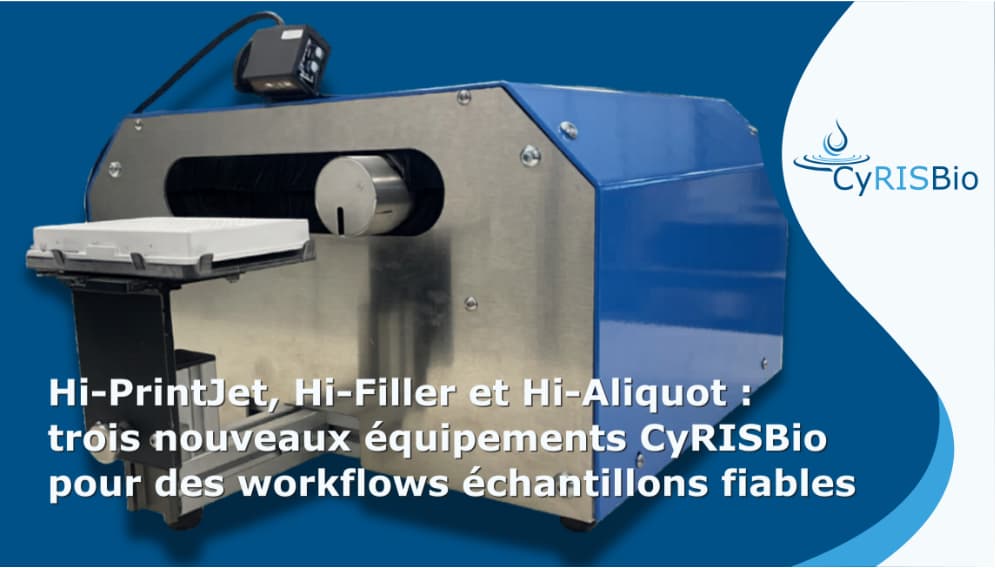
In your laboratories, traceability, repeatability, and precision are critical challenges that can significantly impact your results. Common issues include barcodes becoming unreadable after freezing, batch-to-batch variations during filling, and slow, error-prone aliquoting as formats and destinations multiply.
After months of rigorous testing and refinement, CyRISBio is introducing three new specialized devices designed to secure these processes: Hi-PrintJet, Hi-Filler, and Hi-Aliquot. Developed by our R&D engineers, these three compact modules are designed to make daily laboratory operations more reliable, reproducible, and easier to manage.
Which module for which problem?
But what does each of these devices do, and in which cases are they most relevant?
Hi-PrintJet: identifying microplates without labels
Hi-PrintJet prints barcodes via inkjet directly onto microplates, contact-free and label-free.
If your laboratory stores plates in cold conditions and needs to scan them reliably (for example, for high-throughput screening), labels can become the weak link. When a barcode fails, the entire process slows down or stops, leading to manual checks and re-labeling. Sometimes, samples are even lost. Cold storage and handling introduce additional failure risks, such as condensation, reduced adhesion, edge lifting, and unreadable codes after repeated freeze/thaw cycles.
Hi-PrintJet, a device dedicated to marking microplates in laboratories, reduces these risks: traceability becomes robust, reading is reliable, integration with your standard scanners and LIMS workflows is simple, and the system is adaptable to various microplate formats.
Hi-PrintJet can also be easily integrated into an automated platform for even greater flexibility and reliability.
Hi-Filler: reproducible filling
Hi-Filler is a compact filling system for microtubes, tubes, vials, and small bottles.
If you perform small to medium-volume filling (for example, for test kits, reagents, or supplies for biobanks/biological libraries), you often find yourself in a "gray area": volumes are too high for manual filling to remain reliable and cost-effective, but not high enough to justify a full production line.
Manual filling can also create batch-to-batch variations, especially during long runs, under time pressure, or with difficult liquids. Hi-Filler allows you to standardize dispensing and reduce errors without turning filling into a major production engineering project.
Thanks to its compact size, the Hi-Filler is easy to integrate onto a lab bench. It improves reliability and is suitable for lab-scale batches, including those involving foaming or viscous liquids.
Hi-Aliquot: simple and precise aliquoting
Hi-Aliquot is a compact aliquoting system that combines a robotic arm with a pipettor. It automatically transfers a defined volume from a source tube to one or more destination tubes.
If your laboratory processes a large number of incoming samples and regularly needs to divide them into multiple portions (hospital and medical analysis labs, biobanks, high-throughput R&D/QC), manual aliquoting quickly becomes a weak point.
Hi-Aliquot simplifies and streamlines this process: load the tubes, enter the required information, and launch the program via an intuitive graphical interface. It is also a scalable platform that can be configured for different workflows, including transfers between tubes and microplates, depending on your needs.
Why these modules instead of an all-in-one platform?
Hi-PrintJet, Hi-Filler, and Hi-Aliquot were born from recurring questions from our clients and very concrete operational problems that create discrepancies, require workarounds, and cause time loss.
Our method is deliberately focused on problem-solving. Before choosing a technology or developing a product, we seek to clarify what is not working, under what conditions, and why. Once the failure mode is clearly identified, it becomes possible to find the appropriate solutions to resolve it.
This explains our modular approach. Rather than imposing an all-in-one platform, we create dedicated modules to counter the failures identified in the process.
In practical terms, modularity allows you to:
- Start small, without disruption: secure one step (identification, filling, or aliquoting) without upending your existing workflow, ensuring minimal impact on procedures and validation, and thus reducing the cost of change.
- Adapt without restarting: when volumes, consumables or destinations change, you adjust the specific module rather than rebuilding an entire platform: you evolve your workflow according to your needs.
- Operate and maintain for the long term: dedicated devices that are simpler to maintain (training, maintenance, parts, troubleshooting).
In regulated environments, every workflow modification can incur validation costs. Isolating risks to individual steps helps control these costs and limits the impact of changes.
Share your challenges with us and we will find a tailored solution
The Hi-PrintJet, Hi-Filler, and Hi-Aliquot were officially launched at the Forum Labo Lyon, held from March 10 to 11, 2026. Did you miss the demonstrations of these instruments and would like to learn more about how these robots could transform your laboratory operations? Contact us !
Tell us which step you want to stabilize (identification, filling, or aliquoting), and share your formats, volumes/throughput, cold chain constraints, and traceability requirements with us. You can count on us to guide you through clarifying the points to check and to answer your questions.