A review published in 2026 shows that, despite significant progress made by biobanks, practices remain highly heterogeneous: in many institutions, manual management and paper-based tracking are still prevalent. A common problem encountered is having storage software that knows where a sample is located on one hand, and clinical trial data describing its characteristics on the other, without these two types of information being easily linked.
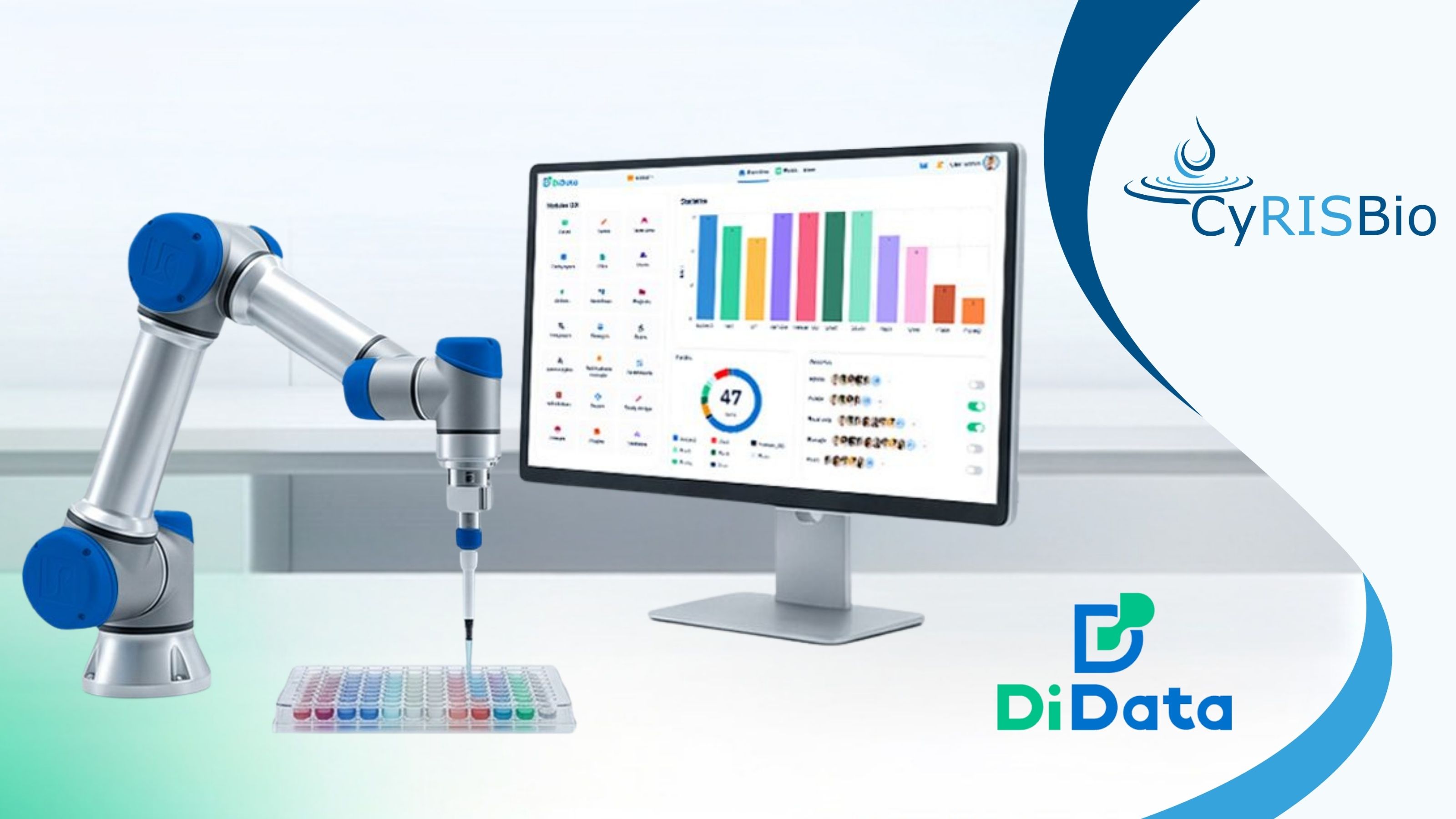
This gap illustrates one of the challenges that laboratory automation seeks to address: connecting a centralized orchestration system, equipment, robotic systems, and data into a continuous digital workflow. The partnership between CyRISBio and DiData is part of this dynamic. It allows us to address the major challenges of sample management: traceability, precision, efficiency, and security.
Why we chose this partnership with DiData
DiData is a player specialized in software development, whose flexibility perfectly complements our expertise in custom automation. This choice is based on three key elements:
- A module designed with users. DiData co-developed its biobank module, SMPL, with the Swiss Biobanking Platform, a national network federating Swiss biobanks according to internationally harmonized standards. Since then, the software has also been deployed in leading biological resource centers in France (Amiens University Hospital and Marseille University Hospital).
- A Laboratory Information Management System (LIMS) modular, ready-to-use solution. The software intuitively guides users step-by-step and adapts to the evolving needs of the biobank.
- A business model compatible with academic and hospital budgets. An annual per-user license, including updates, with no need to repurchase licenses for new versions. The solution is suitable for both small sample volumes and large biobanks.
Customizable software for complete traceability
In modern laboratories, efficiency comes from software that intelligently orchestrates various pieces of equipment. On the DiData platform, you can create your own workflows in a visual editor without writing a single line of code. Thanks to its modular and interoperable architecture, the software can be expanded to meet the needs of any project. From day one, the client has a tool designed specifically for them.
A single interface allows you to manage samples and oversee clinical studies. For each sample, the system records parameters such as identity, physical state, available quantity, location, as well as donor consent and associated terms of use. For example, a biobank manager can see at a glance what percentage of a sample collection has already been used.
How does it work in practice? When a sample is removed from a connected freezer, the barcode or QR code reader transmits the information to the platform, which links it to the relevant cohort or clinical study. There is no longer any need for manual data entry: every action is recorded in a history associated with the user, date, and context. DiData goes even further by offering a 3D reconstruction of the freezer, drawer by drawer and box by box, allowing you to find a specific sample by "walking through" it virtually. It also monitors temperatures in real time and automatically alerts you in the event of an anomaly.
For your biobank: a complete sample management offering
Managing your samples begins the moment they are tubed, labeled, and stored. CyRISBio covers this physical chain through its laboratory robotics and automation solutions, its incubators and storage hotels and its SAFE (Store Aliquots For Ever) range: 100% IATA-tested 2D tubes, permanent marking, automation-ready SBS racks, tube presenter, torque-controlled capping/decapping systems, 2D scanning.
With DiData, CyRISBio bridges the gap between the physical world and the digital world of your samples. We handle the deployment of the DiData platform and the integration of your instruments, all with local support based in France. Migrating your existing data (Excel files, paper logs, or current LIMS) is part of our scope: we analyze the volume and quality during the scoping phase, prior to any production rollout.
Once deployed, a connected laboratory offers three key benefits:
· Fewer errors, greater reliability. Information is entered once and flows seamlessly between equipment and the LIMS, reducing manual re-entry, location errors, and fragmented files.
· End-to-end traceability, audit-ready. Each sample maintains its identity, location, status, history, and link to its cohort or study, documenting processes, supporting GMP and 21 CFR Part 11 requirements, and simplifying audits.
· More efficient teams. Searching for samples, tracking inventory, and querying cohorts are all accelerated, freeing up time for collection management and research.
The impact varies depending on your profile, but the principle remains the same: an accessible, customizable LIMS integrated with reliable, automation-ready hardware.
Your profile, what the partnership means for you
Small academic biobank => Access to an industrial-grade LIMS without an excessive budget, rapid deployment, and CyRISBio configuration and support in France
Hospital biobank with clinical studies (preparing for NF S96-900 or ISO 20387 certification) => Cohorts and samples consolidated on a single platform, multi-criteria queries in minutes, operational history, and structured exports to simplify audit preparation
Multi-site network => Existing equipment and sites connected on a single platform, no more manual data entry, consolidated stock views, and scalable growth.
Ready to upgrade your biobank? Do you want to reduce the cost and time spent searching for samples to respond to feasibility requests in minutes rather than days?
Our team will work with you to analyze your collections, equipment, management tools, and clinical study requirements to determine if an automation approach is right for your environment.