Retour aux articles

How CyRISBio automated the management of several million tubes for a multi-site biobank

When qualifying high-stakes biological samples, a traceability error can have dramatic consequences. It is against this backdrop of high standards that a healthcare industry player entrusted CyRISBio with the automation of its biobank and sample management. 

Nearly ten years later, the system processes several million tubes across a multi-site network without a single documented failure. This case study illustrates how an architecture co-developed with specialized partners made it possible to meet strict regulatory requirements while achieving substantial savings.

The challenge: flawless traceability and optimal storage conditions, while keeping costs down

The client manages an industrial biobank spread across several sites, dedicated to storing biological samples in a regulated environment. Each specimen must be analyzed, tracked, and qualified within very tight deadlines. Once validated, the samples are stored for several years. In total, the inventory to be managed amounts to millions of tubes.

Before the project, some steps relied on semi-manual processes. These processes were functional but had several limitations: fragmented traceability, limited throughput, and the risk of error. The client therefore required a solution capable of guaranteeing complete tracking within a framework subject to validation and compliance requirements, while significantly reducing operational costs.

Our approach: a custom architecture, co-developed with our partners

CyRISBio made the difference on three points.

1/ The quality of the technical proposal : an architecture designed to meet real-world constraints, based on a deep understanding of the workflow and traceability requirements, which helps to significantly reduce operating costs.

2/ A modular design : this approach of bespoke automation made it possible to combine the best components on the market and adapt each element to the client's specific needs.

3/ Exceptional speed of execution : the traceability and sample management tool was developed in six months. The first site was installed just one month after the contract was awarded.

The final architecture was based on three complementary components, orchestrated by software developed by CyRISBio:

- consumables and a storage system provided by our partner LVL-technologies

- a tube sealing system that provides 30 to 40% in savings

- a module dedicated to reading and identifying tubes, controlled by specialized software

The workflow, in practice: from collection to storage

To truly understand the value of this architecture, you have to look at the workflow as a whole. Starting from the initial collection, several tubes are prepared by pre- and post-analytical systems. One of these is destined for the biobank, where it is aliquoted into storage microtubes.

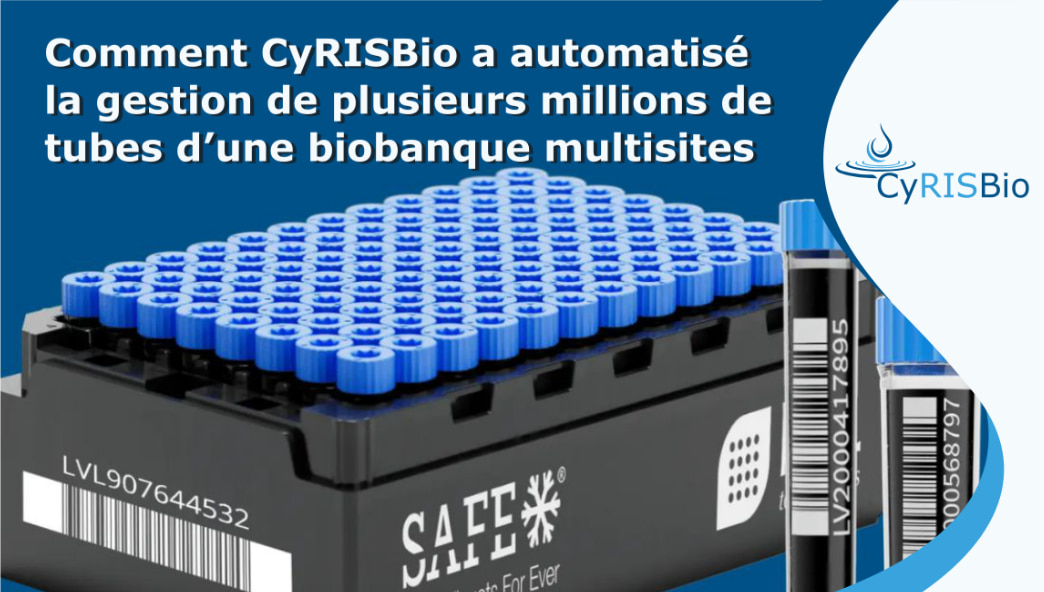
LVL microtubes, equipped with a 2D code readable from the bottom, are arranged in 96-microtube racks. The reader scans the rack and then maps the rack identifier, a specific 1D barcode, and the 2D codes of the microtubes, ensuring large-scale traceability. Once aliquoting is complete, the entire rack is sealed before being stored in cold rooms. 

Beyond simple preservation, the goal of a biobank is increasingly to add value to its collection. It is essential to be able to manage entry/exit workflows while guaranteeing sample traceability. The software component linked to the barcode readers/scanners provides this function while minimizing error risks and operational costs. The software reconstructs the entire chain at any time: collection → tube → rack → location, as well as the reverse. This system replaced an initial Excel-based procedure and has never failed since its implementation.

Results: operational and budgetary profitability, and longevity

The benefits stem from a simple principle: every architectural choice serves both operational performance and budget control. The return on investment, documented by the client, has proven to be substantial. It relies on three levers.

By fully automating critical steps while keeping other solutions leaner, the client achieved a lower acquisition cost than integrated market solutions, without compromising on throughput or traceability.

The end-to-end managed workflow replaced semi-manual steps: less technician time per tube processed, less repetitive strain, and a significant cumulative effect across a multi-site fleet of several million tubes.

Traceability is continuously guaranteed by the software. Regulatory risk is structurally contained, and the collection remains fully usable over time.

For CyRISBio, however, the best proof of a solution's quality remains its longevity. 

"Nearly ten years later, the system is still in place"

This project also illustrates what sets the best partnerships apart: active listening to the client's needs, incorporating operational and budgetary constraints from the outset to generate significant savings without compromising performance. This approach sums up the CyRISBio philosophy: innovation, excellence, and responsiveness in service to our clients.

Your biobank deserves a custom solution

Are you currently managing large volumes of samples using semi-manual processes, finding that traceability is becoming difficult to ensure, or that regulatory requirements are putting increasing pressure on your teams? 

Don't wait until you have all the answers. 

Request a workflow audit

→ Contact our experts

Have an automation project in mind?

Describe your process to us, and we will propose a custom solution.

Contact us

Foire aux Questions

Voit notre FAQ

What is the average lead time from initial contact to the delivery of a final solution?

The average lead time for small-scale automation is around 3 months. For more complex laboratory automation, it varies between 4 and 10 months, with an average of 6 months.

Does CyRISBio partner with specialized manufacturers for its pipetting solutions?

Yes, CyRISBio distributes, among other things, Analytik Jena's CyBio automated pipetting platforms, which are used for laboratory liquid handling.

What does CyRISBio's sample management offering include?

Our sample management offering covers automated low-temperature storage (biobanking), incubators, and storage hotels, as well as associated consumables such as compatible microtubes and racks, notably through our partner LVL-Technologies.

What does CyRISBio's laboratory automation offering consist of?

CyRISBio provides automation solutions for liquid handling and dispensing, as well as the integration of robotic platforms to automate complete laboratory workflows, notably leveraging Analytik Jena's CyBio liquid handling platforms.

Does CyRISBio manufacture its own equipment or distribute partner brands?

CyRISBio designs custom solutions and also distributes equipment from recognized specialized manufacturers in laboratory automation, in order to offer its clients the solution best suited to their process constraints.

Which industry sectors does CyRISBio support?

CyRISBio supports laboratories across several sectors: pharmaceuticals, cosmetics, chemicals, food processing, and biology, with automation solutions tailored to each type of process.

Who is CyRISBio?

CyRISBio is a French company specializing in laboratory automation, founded in 1999. Based in Chaponost, in the Lyon region, it designs and distributes robotic and instrumented solutions for laboratory pipetting and sample management.

We want to automate a manual process but have technical concerns regarding our workflows; can we conduct a POC with you?

Yes. Transitioning from a manual laboratory process to an automated one can indeed raise a number of questions and challenges. We will work on providing automation sub-components to address these issues. These will be handled through micro-developments that will strengthen the final solution.

Is there a cost for being put in touch with your project engineers to evaluate a solution for our automation needs?

No! The initial introductory meeting often takes place via video conference. This allows us to quickly and easily introduce ourselves and assess our mutual interest in moving forward. If both parties decide to work together, the project engineer begins their work, and billing is triggered upon the successful completion of the operation.

Do you need detailed specifications to start an automation project?

The more detailed your laboratory automation requirements are, the less room it leaves for our creativity. Ideally, you should define your needs and outline your processes clearly; the final specifications will be established after a few exchanges with the project engineer in charge.

Can you mix tube formats in an automated sample storage Biobank?

Yes, absolutely. It is possible to mix different types of cassettes with varying heights within the automated sample storage system. This allows you to combine everything from tiny 300 µL tubes to 2 mL tubes.

What is the maximum capacity of your -80°C Biobank?

LiCONiC builds custom Biobanks tailored to your required capacity. There are no capacity limits. Examples of previously manufactured systems include the STC 101k0-ULT.

This automated -80°C sample storage system has a capacity of 3.6 million 1 mL tubes, or 38,400 racks of 96 tubes. By using high-density (HD) racks, the capacity increases by over 40% to reach 5.5 million tubes.

What is the smallest capacity of your -80°C biobank?

The smallest automated -80°C sample storage system, the STT 1.5K ULT, has a capacity of 49,920 1 mL tubes, or 520 96-tube racks. By using smaller 300 µL tubes, for example, the capacity increases to 122,800 tubes.

Where are LVL-Technologies 2D microtubes manufactured? Is the supply chain secure and reliable?

The Safe® range of 2D microtubes is designed, manufactured, and tested in Europe within controlled industrial environments that meet the rigorous demands of scientific and biotechnological applications.
This European production ensures consistent quality, full batch traceability, and strict compliance with international standards.

Control over the production and supply chain allows LVL-Technologies to ensure reliable and long-term product availability, even for large-scale projects or long-term biobanking initiatives.
This approach protects users against supply chain disruptions and ensures the continuity of critical research and sample storage operations.

How can I increase storage space in my -80°C freezers?

Significant space savings can be achieved by replacing internal thread tubes with external thread 2D microtubes.
Thanks to the cap design, where the thread sits on the outer top edge of the tube, this configuration allows for reduced height and therefore increased storage density.
Furthermore, switching from 9×9 or 10×10 cryoboxes to an SBS format saves additional space while paving the way for future biobank automation.
Finally, integrating the Hi-Thèque software helps regularly optimize stock organization while ensuring complete and secure sample traceability, both on-site and remotely.
Our teams are at your disposal to assist you with all initiatives aimed at sustainably optimizing your storage capacity.

Are the 2D microtubes in the Safe range guaranteed RNase/DNase-free?

Yes. The 2D microtubes in the Safe® range are guaranteed RNase-free and DNase-free.
They are manufactured under controlled, sterile conditions and undergo strict quality procedures, ensuring their compatibility with molecular biology and genomics applications, as well as the storage of high-value scientific samples.

How can I effectively manage the storage of my 2D microtubes in -20°C or -80°C freezers or liquid nitrogen tanks?

The Safe® range of 2D microtubes is designed to be stored in standard SBS racks or cryoboxes.
LVL-Technologies also offers customized metal storage boxes, compatible with the main models of refrigerators, freezers, and liquid nitrogen tanks available on the market.
Individual identification via 2D DataMatrix code ensures fast, reliable, and secure sample management, facilitating inventory and storage space optimization.
For advanced management, the use of automated scanning systems and tracking software is highly recommended.

In this regard, the Safe® range from LVL-Technologies includes a new generation of scanners capable of reading all types of 2D microtubes, either individually or in SBS racks and/or 9×9 or 10×10 cryoboxes.

Is it possible to evaluate the chemical inertness of the 2D microtube plastic with respect to biological substances?

Yes. The 2D microtubes from the LVL-Technologies Safe® range are manufactured from medical-grade polypropylene (USP Class VI), selected for its high chemical inertness, very low extractables, and compatibility with demanding biological applications.
These materials are perfectly suited for the long-term storage of sensitive biological samples and limit interactions with DNA, RNA, proteins, or other analytes, even under ultra-low temperature conditions over long periods.
Quality and compliance evaluation tests have been conducted to meet the standards of research laboratories and biobanks. Detailed results are available in the LVL-Technologies Technote, upon request.

Should you choose external or internal threading for ultra-low temperature storage?

For ultra-low temperature storage (-80°C and below), LVL-Technologies recommends using external thread 2D microtubes.

This configuration significantly reduces the contact surface between the sample and the inside of the cap, thereby limiting the risk of cross-contamination, material transfer, or unwanted physical-chemical interactions.
These risks are particularly high with internal thread tubes during agitation or centrifugation, where liquid samples can rise and pool along the internal thread.
A comparative study detailing these phenomena is available in the LVL-Technologies Technote, accessible to all our users upon request, in either paper or electronic format.