Retour aux articles

High-throughput screening in agrochemistry: how CyRISBio helped automate and miniaturize a complex workflow

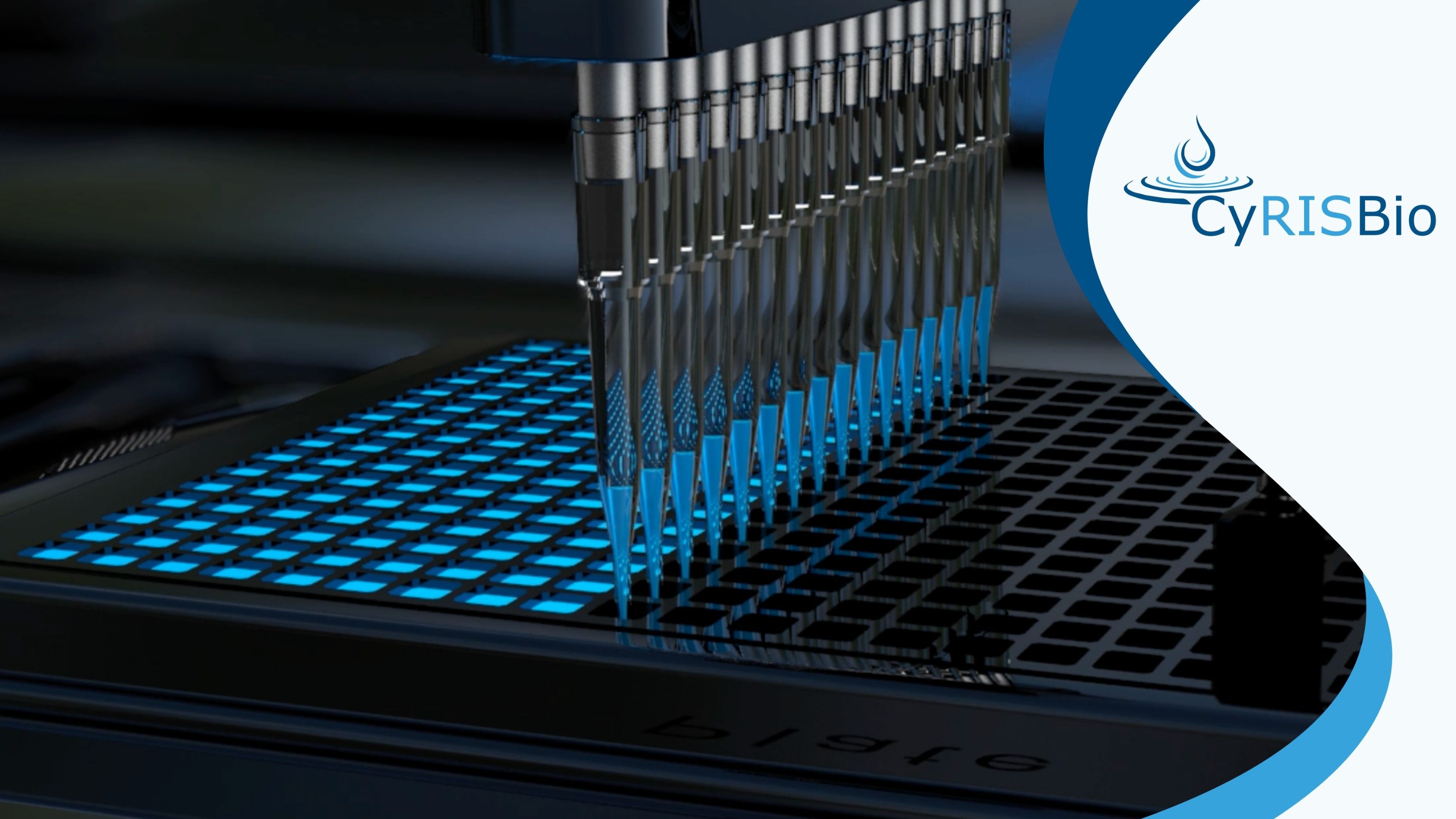
When it comes to performing continuous biological screens across hundreds of 384-well microplates, workflow synchronization, traceability, and platform flexibility become critical challenges. Finding a robotic platform that met specific technological criteria while overcoming space constraints for implementation were the challenges our client faced while searching for new crop protection solutions.

The Initial Situation and Project Challenges

Prior to this project, high-throughput protocols using 96-well plates existed, but the platform did not provide the desired flexibility. The implementation of a new evaluation technology, combined with new technical requirements, necessitated a new automated platform.  In a regulatory environment requiring the adoption of new approaches while maintaining exemplary quality, CyRISBio was called upon to optimize this testing process.

The proposed workflow was complex. One of the client’s key requirements was to test different doses on multiple pathogens using molecule libraries stored in 384-well master plates. Thus, each master plate generates dozens of test plates to be evaluated. The goal was to scale the platform to process up to 150 plates per run while maintaining the ability to use the platform’s various components as independent modules.

At this scale, several parameters became critical:

-       Molecule volume: testing entire libraries required high throughput

-       Traceability: each plate (master, daughter, assay) had to be identified by barcode, and each dispensing recorded precisely; what dilution, in which plate, for which pathogen

-       The ability to perform automated, traceable incubation

-       Data volume: implementing microscopy-based evaluation produced hundreds of images per well, requiring traceability for each test step

-       The software interface had to be user-friendly and flexible.

-       Management of traceability files to ensure effective communication with the data management team

Our tailored approach to co-developing a high-performance platform

1. A solid initial framework designed to evolve

Our approach was multifaceted. Securing the fundamentals (throughput, sterility, traceability, and flexibility in module usage) was key. At the same time, we maintained the ability to evolve and refine the design as new insights emerged, all within a limited space. With such an ambitious project, each question led to another, and the final deliverable exceeded the initial scope.

2. Workflow Design and Coordination

The goal was to ensure a seamless workflow of dilutions, pathogen dispensing, lid management, plate securing, and microscopic reading. All of these steps had to be performed under a controlled, sterile atmosphere to protect both the user and the experiment.

To eliminate timing variations and maximize throughput, we focused on several key areas. First, we implemented a disc-type pipetting system that can store nearly 150 plates with covers in a compact space. This allows the plates to be handled directly at the pipetting station, eliminating the need to travel back and forth to a remote storage rack. Second, we developed a custom storage rack organized into cassettes of 30 microplates to match the test’s plate requirements. Finally, we developed software to orchestrate the platform. It schedules sequences, anticipates bottlenecks, and ensures reproducibility and traceability over time.

We ensured complete traceability (links between master plates, daughter plates, and assays, along with event logs) so that each plate can be directly processed by data analysis tools. The entire system was integrated under a Class 2 biosafety fume hood (two custom-merged fume hoods), with access from all four corners to allow for rapid intervention in the event of an incident.

3. Planning and Commissioning

Upon receipt of the order, the planning phase took place over two months. The platform was then assembled and tested for five months at our partner Analytik Jena in Germany. During this time, we maintained constant communication with the client’s team regarding software customization.

A Factory Acceptance Test (FAT) was conducted remotely in the midst of the COVID-19 pandemic, which triggered the disassembly and subsequent delivery of the platform. Two months later, the final validation, the Site Acceptance Test (SAT), was completed. A few months later, the client tested known molecules to validate the system, and the platform became operational.

Result: A Smoothly Running Platform

Since its commissioning, the high-throughput screening automation platform has reliably and reproducibly operated in actual production. It has become a strategic tool for identifying new active molecules. Everything runs smoothly and under control, cycle after cycle.

This result is the product of a technical and methodological approach. The quality of the ongoing dialogue made all the difference. Through regular progress meetings, the partners were able to identify areas for improvement and develop solutions that were not included in the initial request.

‍

Key benefits achieved

60,000 test wells per run, launched nearly daily

< 14 months : Operational platform from order placement to production launch during the COVID-19 pandemic

✓ Controlled reproducibility thanks to robust and reliable components.

✓ Full traceability for each sample, from the master plate to the analysis results.

Is your workflow ready to scale up?

Do you currently process 20, 30, or 50 plates a day using a semi-manual process? Do you feel that your process lacks reproducibility, or that your team spends too much time managing data instead of analyzing it? Now is the time to start a conversation with CyRISBio.

Don’t wait until you have all the answers. Let’s talk →

Have an automation project in mind?

Describe your process to us, and we will propose a custom solution.

Contact us

Foire aux Questions

Voit notre FAQ

What is the average lead time from initial contact to the delivery of a final solution?

The average lead time for small-scale automation is around 3 months. For more complex laboratory automation, it varies between 4 and 10 months, with an average of 6 months.

Does CyRISBio partner with specialized manufacturers for its pipetting solutions?

Yes, CyRISBio distributes, among other things, Analytik Jena's CyBio automated pipetting platforms, which are used for laboratory liquid handling.

What does CyRISBio's sample management offering include?

Our sample management offering covers automated low-temperature storage (biobanking), incubators, and storage hotels, as well as associated consumables such as compatible microtubes and racks, notably through our partner LVL-Technologies.

What does CyRISBio's laboratory automation offering consist of?

CyRISBio provides automation solutions for liquid handling and dispensing, as well as the integration of robotic platforms to automate complete laboratory workflows, notably leveraging Analytik Jena's CyBio liquid handling platforms.

Does CyRISBio manufacture its own equipment or distribute partner brands?

CyRISBio designs custom solutions and also distributes equipment from recognized specialized manufacturers in laboratory automation, in order to offer its clients the solution best suited to their process constraints.

Which industry sectors does CyRISBio support?

CyRISBio supports laboratories across several sectors: pharmaceuticals, cosmetics, chemicals, food processing, and biology, with automation solutions tailored to each type of process.

Who is CyRISBio?

CyRISBio is a French company specializing in laboratory automation, founded in 1999. Based in Chaponost, in the Lyon region, it designs and distributes robotic and instrumented solutions for laboratory pipetting and sample management.

We want to automate a manual process but have technical concerns regarding our workflows; can we conduct a POC with you?

Yes. Transitioning from a manual laboratory process to an automated one can indeed raise a number of questions and challenges. We will work on providing automation sub-components to address these issues. These will be handled through micro-developments that will strengthen the final solution.

Is there a cost for being put in touch with your project engineers to evaluate a solution for our automation needs?

No! The initial introductory meeting often takes place via video conference. This allows us to quickly and easily introduce ourselves and assess our mutual interest in moving forward. If both parties decide to work together, the project engineer begins their work, and billing is triggered upon the successful completion of the operation.

Do you need detailed specifications to start an automation project?

The more detailed your laboratory automation requirements are, the less room it leaves for our creativity. Ideally, you should define your needs and outline your processes clearly; the final specifications will be established after a few exchanges with the project engineer in charge.

‍

Can you mix tube formats in an automated sample storage Biobank?

Yes, absolutely. It is possible to mix different types of cassettes with varying heights within the automated sample storage system. This allows you to combine everything from tiny 300 µL tubes to 2 mL tubes.

What is the maximum capacity of your -80°C Biobank?

LiCONiC builds custom Biobanks tailored to your required capacity. There are no capacity limits. Examples of previously manufactured systems include the STC 101k0-ULT.

This automated -80°C sample storage system has a capacity of 3.6 million 1 mL tubes, or 38,400 racks of 96 tubes. By using high-density (HD) racks, the capacity increases by over 40% to reach 5.5 million tubes.

What is the smallest capacity of your -80°C biobank?

The smallest automated -80°C sample storage system, the STT 1.5K ULT, has a capacity of 49,920 1 mL tubes, or 520 96-tube racks. By using smaller 300 µL tubes, for example, the capacity increases to 122,800 tubes.

Where are LVL-Technologies 2D microtubes manufactured? Is the supply chain secure and reliable?

The Safe® range of 2D microtubes is designed, manufactured, and tested in Europe within controlled industrial environments that meet the rigorous demands of scientific and biotechnological applications.
This European production ensures consistent quality, full batch traceability, and strict compliance with international standards.

Control over the production and supply chain allows LVL-Technologies to ensure reliable and long-term product availability, even for large-scale projects or long-term biobanking initiatives.
This approach protects users against supply chain disruptions and ensures the continuity of critical research and sample storage operations.

How can I increase storage space in my -80°C freezers?

Significant space savings can be achieved by replacing internal thread tubes with external thread 2D microtubes.
Thanks to the cap design, where the thread sits on the outer top edge of the tube, this configuration allows for reduced height and therefore increased storage density.
Furthermore, switching from 9×9 or 10×10 cryoboxes to an SBS format saves additional space while paving the way for future biobank automation.
Finally, integrating the Hi-Thèque software helps regularly optimize stock organization while ensuring complete and secure sample traceability, both on-site and remotely.
Our teams are at your disposal to assist you with all initiatives aimed at sustainably optimizing your storage capacity.

Are the 2D microtubes in the Safe range guaranteed RNase/DNase-free?

Yes. The 2D microtubes in the Safe® range are guaranteed RNase-free and DNase-free.
They are manufactured under controlled, sterile conditions and undergo strict quality procedures, ensuring their compatibility with molecular biology and genomics applications, as well as the storage of high-value scientific samples.

How can I effectively manage the storage of my 2D microtubes in -20°C or -80°C freezers or liquid nitrogen tanks?

The Safe® range of 2D microtubes is designed to be stored in standard SBS racks or cryoboxes.
LVL-Technologies also offers customized metal storage boxes, compatible with the main models of refrigerators, freezers, and liquid nitrogen tanks available on the market.
Individual identification via 2D DataMatrix code ensures fast, reliable, and secure sample management, facilitating inventory and storage space optimization.
For advanced management, the use of automated scanning systems and tracking software is highly recommended.

In this regard, the Safe® range from LVL-Technologies includes a new generation of scanners capable of reading all types of 2D microtubes, either individually or in SBS racks and/or 9×9 or 10×10 cryoboxes.

Is it possible to evaluate the chemical inertness of the 2D microtube plastic with respect to biological substances?

Yes. The 2D microtubes from the LVL-Technologies Safe® range are manufactured from medical-grade polypropylene (USP Class VI), selected for its high chemical inertness, very low extractables, and compatibility with demanding biological applications.
These materials are perfectly suited for the long-term storage of sensitive biological samples and limit interactions with DNA, RNA, proteins, or other analytes, even under ultra-low temperature conditions over long periods.
Quality and compliance evaluation tests have been conducted to meet the standards of research laboratories and biobanks. Detailed results are available in the LVL-Technologies Technote, upon request.

Should you choose external or internal threading for ultra-low temperature storage?

For ultra-low temperature storage (-80°C and below), LVL-Technologies recommends using external thread 2D microtubes.
‍

This configuration significantly reduces the contact surface between the sample and the inside of the cap, thereby limiting the risk of cross-contamination, material transfer, or unwanted physical-chemical interactions.
These risks are particularly high with internal thread tubes during agitation or centrifugation, where liquid samples can rise and pool along the internal thread.
A comparative study detailing these phenomena is available in the LVL-Technologies Technote, accessible to all our users upon request, in either paper or electronic format.