

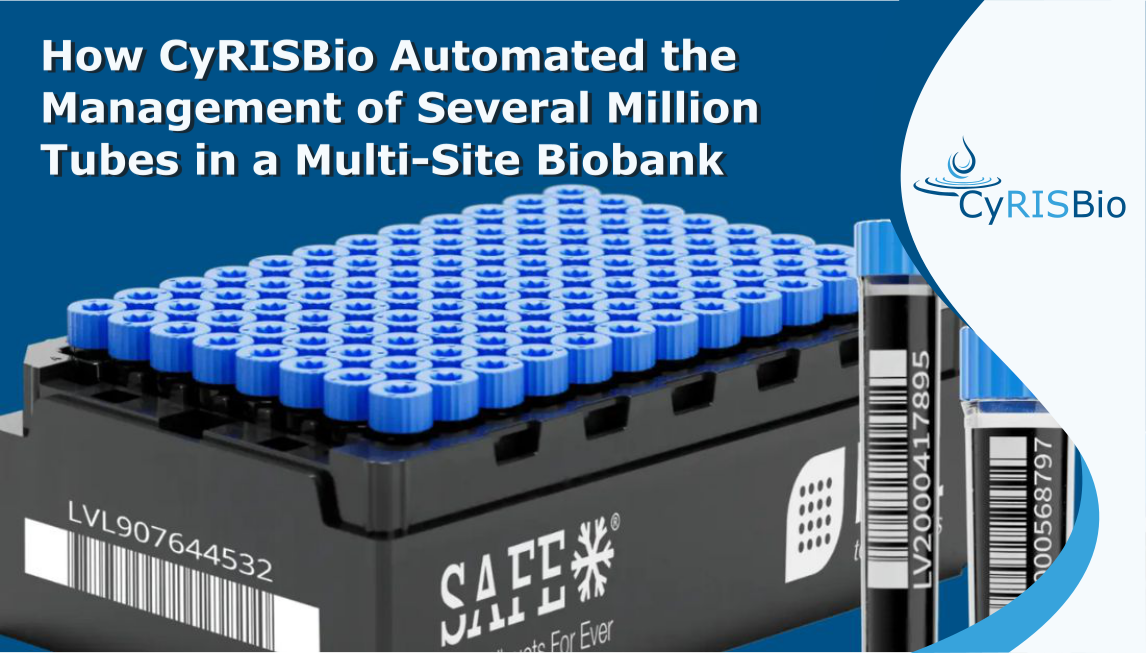
CASE STUDY - BIOBANK AUTOMATION How CyRISBio Automated the Management of Several Million Tubes in a Multi-Site Biobank When qualifying biological samples with major public health implications, even a minor traceability error can have dramatic consequences. Against this backdrop of stringent requirements, a healthcare industry leader chose CyRISBio with automating its sample management. Nearly ten years later, the system processes millions of tubes across a multi-site network with no documented failures. This case study illustrates how the architecture, co-developed with specialized partners, enabled the organization to meet strict regulatory requirements and achieve substantial cost savings. The Challenge: seamless traceability and optimal storage conditions while keeping costs down The client manages an industrial biobank spread across multiple sites that is dedicated to storing biological samples in a regulated environment. Each sample must be analyzed, tracked, and qualified within very short timeframes. After validation, the samples are stored for several years. The total inventory consists of millions of tubes. Before the project, certain steps relied on semi-manual processes. While these processes were functional, they had several limitations, including fragmented traceability, limited throughput, and a risk of error. Therefore, the client required a solution that could ensure comprehensive tracking within a validated and compliant framework while significantly reducing operational costs. Our approach: a custom-built architecture, co-developed with our partners CyRISBio made a difference in three key areas. 1/ The quality of the technical proposal: this includes an architecture designed to meet on-site constraints, based on a deep understanding of the workflow and traceability requirements. It also significantly reduces operating costs. 2/ A modular design: this approach to custom automation allowed us to combine the best components on the market and adapt each element to the client’s specific needs. 3/ Exceptional speed of execution: the traceability and sample management tool was developed in six months. The first site was installed just one month after the contract was awarded. The final architecture was based on three complementary components, orchestrated by software developed by CyRISBio: - consumables and a storage system provided by our partner LVL-technologies - a tube sealing system that enables cost savings of 30 to 40% - a module dedicated to reading and identifying tubes, controlled by specialized software The workflow, in practice: from sample collection to storage To understand the value of the architecture, it is important to look at the entire workflow. Starting with the initial sample collection, pre- and post-analytical systems prepare several tubes. One tube is sent to the biobank, where it is divided into smaller storage tubes. The LVL microtubes, with a 2D code readable from the bottom, are stored in 96-tube racks. A reader scans the rack and then matches its identifier, a specific 1D barcode, with the 2D codes on the microtubes, to ensure large-scale traceability. After aliquoting is complete, the entire rack is sealed and stored in cold storage rooms. Beyond preservation, the goal of a biobank is to leverage its collection. It is essential to manage intake and outflow workflows while ensuring sample traceability. The software component linked to barcode readers and scanners enables this functionality while minimizing errors and operational costs. The software can reconstruct the entire chain at any time: collection → tube → rack → location, as well as the reverse. This system replaced an initial Excel-based procedure and has never failed since its implementation. Results: Operational and budgetary efficiency, and longevity The benefits stem from a simple principle: every architectural choice contributes to both operational performance and budget control. The client has documented substantial return on investment. This return is based on three key factors. For CyRISBio, however, the best proof of a solution's quality is its longevity. “Nearly ten years later, the system is still in place.” This project illustrates the qualities that distinguish the best partnerships: active listening to clients' needs and incorporating operational and budgetary constraints from the beginning to achieve substantial savings without compromising performance. This approach embodies CyRISBio’s philosophy of innovation, excellence, and responsiveness in service to our clients. Your biobank deserves a tailor-made solution Are you currently managing large volumes of samples using semi-manual processes? Are you finding that ensuring traceability is becoming difficult, or that regulatory requirements are placing an increasing burden on your teams? Don’t wait until you have all the answers.
|
customized automation

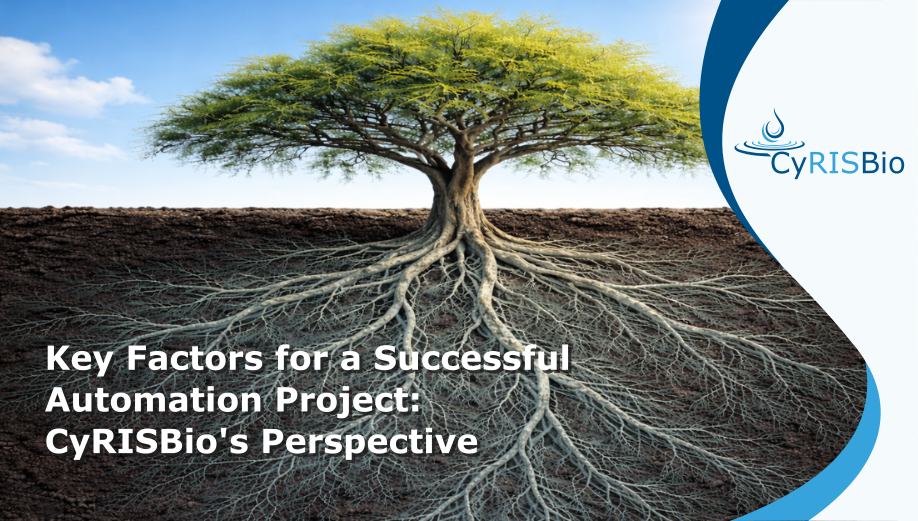
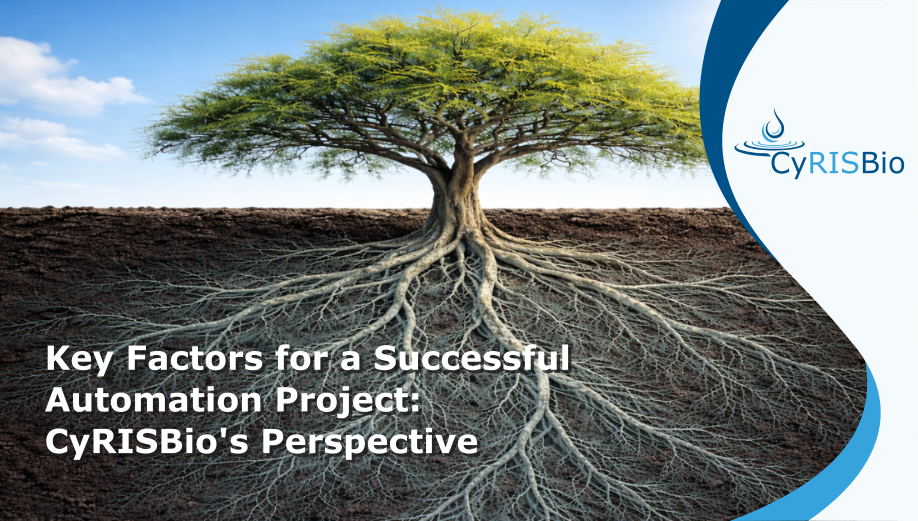
Key Factors for a Successful Automation Project: CyRISBio's Perspective Moving from a manual process to an automated platform is a complex journey. In this context, choosing the right integration partner is critical. An excellent integrator must master the technical requirements, understand the constraints of the laboratory, deliver robust solutions, and reduce risks. Our experience at CyRISBio is to fully understand the project as a whole. Because the true complexity of a project is rarely the visible part of the tree. This is generally well identified by our contacts and relatively well described. However, what happens beneath the surface - the elements of the project that are poorly identified and that most of the time the discussion partners are not even aware of - is where the real challenges of the project lie. In this blog, CyRISBio shares its perspective on the question: what ensures the success of an automation project, from initial scoping to implementation? 1) Human-to-human interaction In an automation project, we often talk about robotics, hardware, software, and performance. But the first risk is often simpler: communication that does not flow in both directions and lacks transparency. We think we understand each other, but unresolved gray areas reappear later in the form of obstacles to project implementation, or an installed platform that "works" but not as the team had understood it. This is why CyRISBio considers the laboratory-integrator relationship to be the key factor in a project's success. For this relationship to be effective, the following must be defined at the outset of the interaction:
2) Get involved early enough Our belief is that the key work is done early on. When the integrator gets involved early in the project, the discussion is more open, and there is more room to design a truly tailored solution, rather than fixing a design that is already set in stone. Conversely, arriving with a fixed set of specifications may be reassuring, but it reduces options and makes improvements more costly. In life sciences, a laboratory workflow is built through contact with reality. If everything is fixed too early, concrete opportunities are missed (simplified flows, secure traceability, actual throughput, future maintenance). This is precisely why CyRISBio is not "locked into a catalog": we start with the lab's problem, then combine the right building blocks to deliver a turnkey solution, as architects of customized automation solutions. Finally, this initial phase allows two key conditions to be verified: is the process ready to be automated, and is the investment justified? This requires the ability to support the equipment over time (resources, maintenance, support, IT/quality) and a realistic ROI. If the ROI is not viable, it is better to adjust the requirements: reduce the scope, partially automate, prioritize the most valuable steps, or relax certain requirements to keep the project viable and sustainable. 3) Characterize all the interconnections The initial requirement is often only the visible part of the tree. The underground part, all the connections and interactions, are the details that will make all the difference: sample constraints, critical time windows, reagent stability, viscosity, batch organization, exceptions, GLP constraints, data, and physical constraints of the site. In manual techniques, people often compensate unintentionally, like an experienced driver who doesn't think about changing gears. In automated techniques, the implicit, i.e., everything that has not been consciously considered in detail when creating the workflow, becomes a source of variation in the result. As Daniel Frayssinhes (Sales Manager at CyRISBio) likes to say, "the devil is in the details." Expertise in life sciences, rooted in the field, makes it possible to identify these key details and their interrelationships. It transforms listening into questioning, bringing the implicit to light before it becomes a problem. This phase of ongoing dialogue aims to make the workflow testable. The integrator pushes for clarification ("in what order?", "with what volume?", "what capacity is needed?", "batch size", "number of daily batches", "what are the critical points in your view", etc.), and the laboratory provides details, even if it means clarifying points and framing exceptions. This step makes it possible to define:
4) Structuring implementation Once all gray areas have been clarified, the next step is to secure the trajectory.
Finally, CyRISBio follows a two-step validation procedure:
When relevant, we also practice an "open door" approach with the customer during certain intermediate phases of the project, particularly during assembly. This reassures, improves communication, and allows certain points to be optimized before the project is finalized. 5) Ensuring proper use of the system An automated platform only adds value if it is used. CyRISBio considers training and after-sales service to be an important pillar of the project, on the same level as hardware and software. The goal is for the team to be able to operate the system independently. In practical terms, this involves role-specific training (operators, superusers, quality/IT if necessary) and detailed documentation (SOPs, start-up/shutdown checklists, error management). A tailored maintenance contract (support, preventive visits, critical parts, interventions according to service level) ensures the system's availability and performance over time. Finally, responsive support, with a single point of contact and clear response times, makes all the difference when an incident occurs. How to choose an integration partner? Two criteria are particularly important when choosing an integrator: 1/ A partner who is committed to consistent communication at every stage, with a dedicated project manager who knows how to ask the right questions from the outset. 2/ A partner who does not lock you into a single solution. Independence from brands allows you to choose the components that are truly suited to your needs, then converge on an offering that is consistent with your workflow and a platform designed for everyday use. Contact our experts! |
