

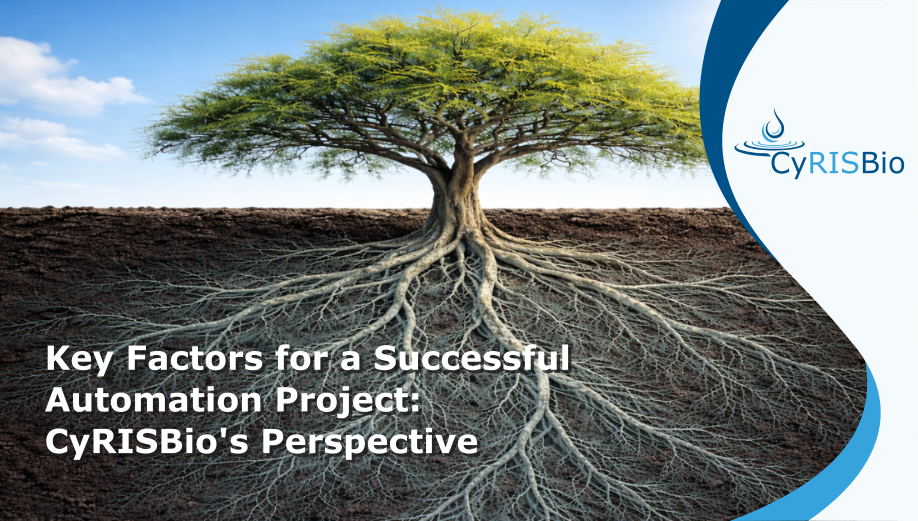
Key Factors for a Successful Automation Project: CyRISBio's Perspective Moving from a manual process to an automated platform is a complex journey. In this context, choosing the right integration partner is critical. An excellent integrator must master the technical requirements, understand the constraints of the laboratory, deliver robust solutions, and reduce risks. Our experience at CyRISBio is to fully understand the project as a whole. Because the true complexity of a project is rarely the visible part of the tree. This is generally well identified by our contacts and relatively well described. However, what happens beneath the surface - the elements of the project that are poorly identified and that most of the time the discussion partners are not even aware of - is where the real challenges of the project lie. In this blog, CyRISBio shares its perspective on the question: what ensures the success of an automation project, from initial scoping to implementation? 1) Human-to-human interaction In an automation project, we often talk about robotics, hardware, software, and performance. But the first risk is often simpler: communication that does not flow in both directions and lacks transparency. We think we understand each other, but unresolved gray areas reappear later in the form of obstacles to project implementation, or an installed platform that "works" but not as the team had understood it. This is why CyRISBio considers the laboratory-integrator relationship to be the key factor in a project's success. For this relationship to be effective, the following must be defined at the outset of the interaction:
2) Get involved early enough Our belief is that the key work is done early on. When the integrator gets involved early in the project, the discussion is more open, and there is more room to design a truly tailored solution, rather than fixing a design that is already set in stone. Conversely, arriving with a fixed set of specifications may be reassuring, but it reduces options and makes improvements more costly. In life sciences, a laboratory workflow is built through contact with reality. If everything is fixed too early, concrete opportunities are missed (simplified flows, secure traceability, actual throughput, future maintenance). This is precisely why CyRISBio is not "locked into a catalog": we start with the lab's problem, then combine the right building blocks to deliver a turnkey solution, as architects of customized automation solutions. Finally, this initial phase allows two key conditions to be verified: is the process ready to be automated, and is the investment justified? This requires the ability to support the equipment over time (resources, maintenance, support, IT/quality) and a realistic ROI. If the ROI is not viable, it is better to adjust the requirements: reduce the scope, partially automate, prioritize the most valuable steps, or relax certain requirements to keep the project viable and sustainable. 3) Characterize all the interconnections The initial requirement is often only the visible part of the tree. The underground part, all the connections and interactions, are the details that will make all the difference: sample constraints, critical time windows, reagent stability, viscosity, batch organization, exceptions, GLP constraints, data, and physical constraints of the site. In manual techniques, people often compensate unintentionally, like an experienced driver who doesn't think about changing gears. In automated techniques, the implicit, i.e., everything that has not been consciously considered in detail when creating the workflow, becomes a source of variation in the result. As Daniel Frayssinhes (Sales Manager at CyRISBio) likes to say, "the devil is in the details." Expertise in life sciences, rooted in the field, makes it possible to identify these key details and their interrelationships. It transforms listening into questioning, bringing the implicit to light before it becomes a problem. This phase of ongoing dialogue aims to make the workflow testable. The integrator pushes for clarification ("in what order?", "with what volume?", "what capacity is needed?", "batch size", "number of daily batches", "what are the critical points in your view", etc.), and the laboratory provides details, even if it means clarifying points and framing exceptions. This step makes it possible to define:
4) Structuring implementation Once all gray areas have been clarified, the next step is to secure the trajectory.
Finally, CyRISBio follows a two-step validation procedure:
When relevant, we also practice an "open door" approach with the customer during certain intermediate phases of the project, particularly during assembly. This reassures, improves communication, and allows certain points to be optimized before the project is finalized. 5) Ensuring proper use of the system An automated platform only adds value if it is used. CyRISBio considers training and after-sales service to be an important pillar of the project, on the same level as hardware and software. The goal is for the team to be able to operate the system independently. In practical terms, this involves role-specific training (operators, superusers, quality/IT if necessary) and detailed documentation (SOPs, start-up/shutdown checklists, error management). A tailored maintenance contract (support, preventive visits, critical parts, interventions according to service level) ensures the system's availability and performance over time. Finally, responsive support, with a single point of contact and clear response times, makes all the difference when an incident occurs. How to choose an integration partner? Two criteria are particularly important when choosing an integrator: 1/ A partner who is committed to consistent communication at every stage, with a dedicated project manager who knows how to ask the right questions from the outset. 2/ A partner who does not lock you into a single solution. Independence from brands allows you to choose the components that are truly suited to your needs, then converge on an offering that is consistent with your workflow and a platform designed for everyday use. Contact our experts! |
Tailor made Laboratory Automation
customized automation